
Dr. Luke Shapiro describes how C5 Hidden Orthodontics can provide an alternative to braces or aligners and give patients a new treatment option.
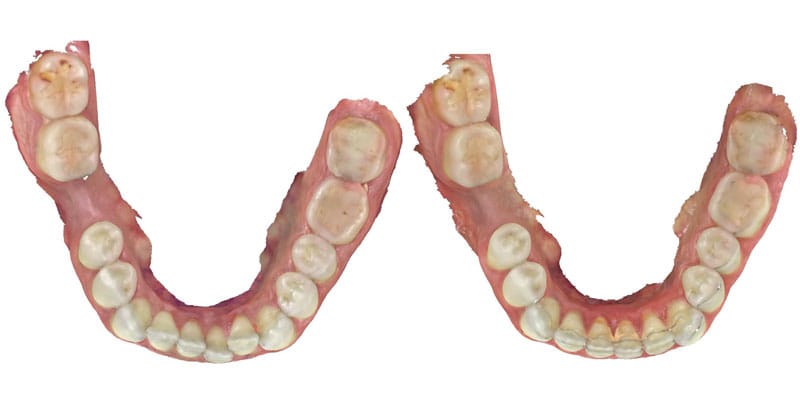
Dr. Luke Shapiro describes an alternative to traditional braces or clear aligner therapies
Have you come across patients who refuse braces due to esthetics and also aligners because they refuse to wear them? And then you offer them lingual braces, but they say that type of appliance is too bulky and hard to clean. So what do you do? Offer them a nighttime Hawley appliance with springs and hope for the best? Now, there is an option to help these patients with C5 Hidden Orthodontics, a key technology from Alta Smiles.
C5 Hidden Orthodontics is a thin .010 or .012 inch diameter NiTi wire designed to straighten the upper or lower incisors with zero visibility. The wire is bonded indirectly with a customized tray to the lingual portion of the teeth, similar to a bonded lingual retainer. What sets C5 Hidden Orthodontics apart is its specialized coating that dissolves after bonding the composite and allows for sliding mechanics so the NiTi wire can exert a gentle but effective force on the teeth. The wire is then adjusted about every 8 to 10 weeks by removing the composite from certain teeth and rebonding it either with floss or a scaler to bend the NiTi wire to exert additional force. The appointments can be pushed out further since most patients don’t mind the thin wire, and it allows for continual activation of the wire. The C5 Hidden Orthodontics system also uses auxiliaries such as segmental wires and GC closing springs to help achieve certain movements.
In addition to standalone use, C5 Hidden Orthodontics can be a highly effective adjunct to clear aligner therapy. Clear aligners, while highly popular for their esthetics and comfort, may not always provide the necessary force to address certain movements, such as precise rotations or minor tooth tip adjustments. In such cases, C5 Hidden Orthodontics can be introduced to help correct these specific movements without requiring visible attachments on the anterior teeth. It can also be used for patients who experience “aligner burnout.” Furthermore, C5 Hidden Orthodontics is a beneficial tool for patients who prefer not to have anterior attachments. By utilizing this treatment, providers can bypass the need for these visible attachments and still achieve difficult movements like extrusion.
Another nice part about C5 Hidden Orthodontics is the ability to use V5x, which is a dental monitoring system. The patients send photos prior to their appointment so that the clinician can discuss the case with the clinical team at Alta Smiles and plan the next step before the patient appointment.
At the end of the day, C5 Hidden Orthodontics is utilizing the power of NiTi wires to exert pressure on teeth to move. Even though the wire is so light, the teeth move very efficiently. It also uses digital planning to place the wire and composite glue pads on the most optimal place on the tooth. It is important to understand the biomechanics of tooth movement, as we are dealing with round wires exerting force on different positions on the tooth. We use a neodiamond bur to cut the ends of the wire. As treatment progresses and the teeth align, it is possible for excess wire to slide out the distal of the canines similar to brackets and wires.
Some difficulty with C5 Hidden Orthodontics can be during the bonding process because the area has to be very dry, and the tongue is right there. Also when adjusting the wire, the clinician has to be careful not to be aggressive with the wire, especially when doing IPR, so the wire doesn’t break. But even if it breaks, it is fixable because segmental wire mechanics can be used, or a new wire can be ordered and placed.
The best thing about C5 Hidden Orthodontics is the patient’s reaction. Most patients have been looking for an alternative to braces or clear aligner therapy for a long time. Then when they see this working within a month, they are so excited!
This information was provided by AltaSmiles.
When an alternative to braces or aligners or a combination of both is needed, orthodontists can get creative. Read about how Dr. Bryan Lockhart solved a complex issue in “The multifactorial challenges to treating non-growing adult Class III patients” here:
Stay Relevant With Orthodontic Practice US
Join our email list for CE courses and webinars, articles and mores